Mining Uptime: The Quiet Driver of Monthly Revenue
A 30-day month holds 720 hours, so one percentage point of uptime is 7.2 hours of lost production. At 1,000 TH/s that point is worth about $12.12, at 300 TH/s about $3.64 and at 100 TH/s about $1.21 — at difficulty 132.76 T, a BTC price of $85,294 and the listed 4% fee already deducted. Uptime decisions are usually made by feel and paid for in cash.

Key takeaways
- Downtime is priced per hour, not per event: 1 hour idle costs about $0.17 at 100 TH/s, $0.51 at 300 TH/s and $1.68 at 1,000 TH/s.
- One percentage point of uptime equals 7.2 hours a month, which is $1.21, $3.64 or $12.12 depending on fleet size.
- Throttling hides inside uptime statistics: a machine running at reduced clock still counts as online while producing less.
- Compare the pool's count of your hashrate with the sum of your own machines. A 5% gap on a 1,000 TH/s fleet is about $12 a day.
Downtime is a rate, not an event
Mining income accrues continuously and stops the instant a machine stops submitting shares. That makes uptime arithmetic unusually simple: the loss is the hourly rate multiplied by the idle hours, with no compounding or second-order effects to worry about. At difficulty 132.76 T, one TH/s produces about 0.0000004735 BTC a day, or $0.0388 after the listed 4% fee on the PPS-settled block reward. Divide by 24 and every terahash of idle capacity forfeits about $0.0016 an hour.
The rate framing changes how faults should be prioritised. A single machine that reboots nightly for six minutes loses a tenth of an hour a day, which is 0.4% of a month — small on its own and worth fixing only when it affects a whole rack at once. A cooling failure that pulls forty machines back to half clock for a day costs more than a complete outage of two machines for the same period, because partial throttling affects more capacity for longer.
That is why uptime has to be measured against something external. Local monitoring reports what a machine says it is doing. The pool reports what your account actually contributed, which is the figure the payout is calculated from. When those two diverge, the difference is the money being lost.
What a percentage point is worth
The table converts downtime hours into dollars for three fleet sizes, using income after the listed 4% block-reward fee. Reading down a column shows how quickly a maintenance habit turns into money at scale.
| Downtime in a 30-day month | At 100 TH/s | At 300 TH/s | At 1,000 TH/s |
|---|---|---|---|
| 1 hour | $0.17 | $0.51 | $1.68 |
| 7.2 hours, or one uptime point | $1.21 | $3.64 | $12.12 |
| 28.8 hours, or a 96% month | $4.85 | $14.54 | $48.47 |
| 72 hours, or a 90% month | $12.10 | $36.36 | $120.96 |
Two conclusions fall out of this. First, a 90% month is expensive in a way that never appears on an electricity bill — at 1,000 TH/s it is close to $121 of production that simply did not happen. Second, the comparison against fee choices is instructive: the entire spread between the listed 4% and 2% block-reward fees at 1 PH/s for a month is $24.23, roughly two percentage points of uptime at the same size. Both numbers belong in the same planning document.
Worked example
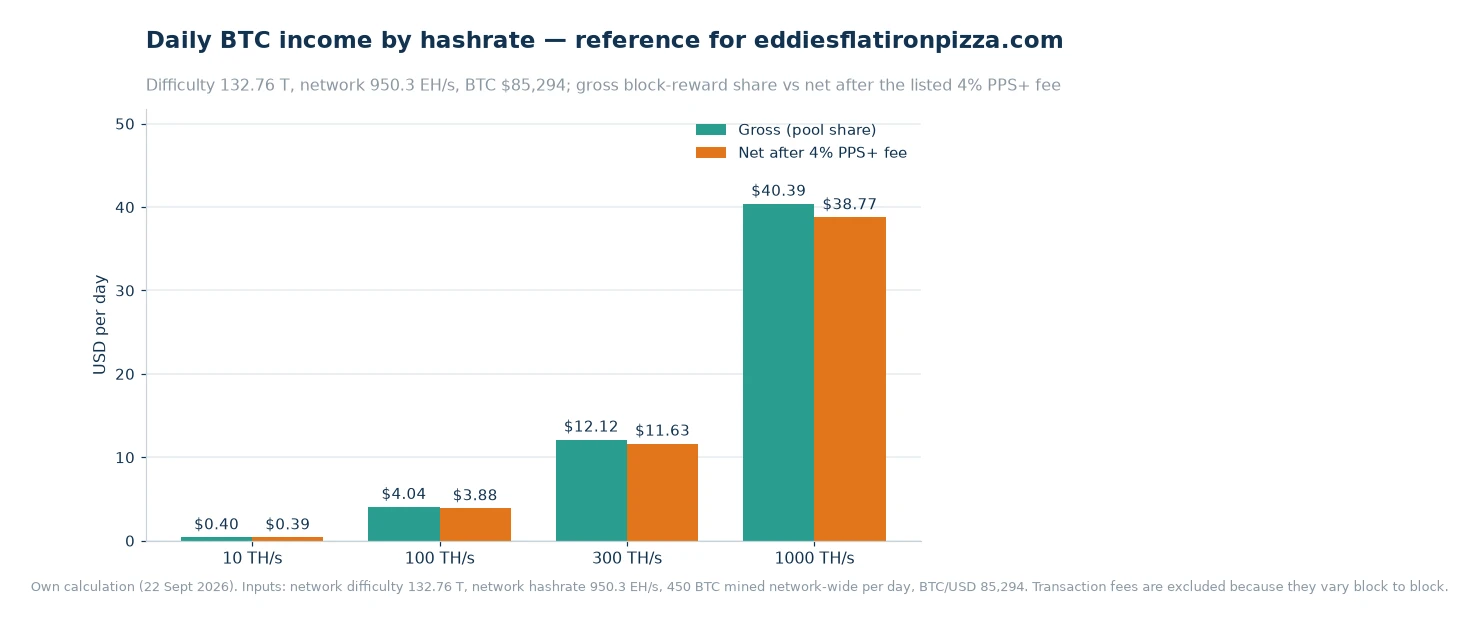
Take a 1,000 TH/s fleet with a 97% month. Step one, the monthly benchmark: 1,000 TH/s multiplied by 0.0000004735 BTC per TH/s per day is 0.00047353 BTC a day, which is $40.39 gross at $85,294, or $38.77 after the listed 4% fee. Step two, the full month: 30 days at $38.77 is $1,163.10.
Step three, the loss: 3% of 720 hours is 21.6 idle hours. At the fee-adjusted hourly rate of about $1.62, that is roughly $34.89 of production that did not happen, leaving about $1,128.21 for the month. Step four, the attribution: if the hours came from four separate events, each one cost about $8.72, and each one is worth investigating separately rather than being absorbed as normal.
Step five is the check that keeps the estimate honest. Compare the pool's reported hashrate for the account against the sum of the local machines over the same window. A fleet showing 1,000 TH/s locally but 950 TH/s at the pool is losing about $1.94 a day at these inputs, near $58 a month — the same order of magnitude as the downtime itself, and usually the result of stale workers or rejected shares rather than anything visible on a machine dashboard.
Where the missing hours actually go
Thermal throttling is the largest and least visible category. Fans spinning at full speed, intake air above the design temperature and clocks pulled back produce a machine that never goes offline and never produces its rated output. On a hot afternoon a fleet can lose several percent of output while every dashboard reports green.
Maintenance windows come next. Firmware updates, cleaning and cable work all take machines offline, and the cost is only visible if the window is planned and timed. Doing that work at a scheduled hour, with the fleet back before the next difficulty adjustment, turns an unmeasured loss into a known one.
Then there is connection and configuration loss: a worker that reconnects to the wrong account name, a share difficulty set so high that stale submissions pile up, or a pool-side switch that leaves part of the fleet pointing elsewhere. These are cheap to fix and expensive to leave, which makes the comparison habit the highest-value routine in the whole operation. On ViaBTC accounts it takes one screen: the pool hashrate page shows what the pool attributes to you, and the pool statistics view fills in network hashrate and difficulty for the same period. A ViaBTC Mining Guide covers the account setup side, which is where most attribution faults start.
Finally, keep the measurement cheap. A daily note of the gap between local and pool hashrate, taken at the same hour, produces a usable uptime series in a month. That series is what tells you whether the last maintenance decision helped.
Frequently asked questions
How much does one percent of downtime cost?
One point is 7.2 hours in a 30-day month. At difficulty 132.76 T and a $85,294 BTC price it is about $1.21 at 100 TH/s, $3.64 at 300 TH/s and $12.12 at 1,000 TH/s, using income after the listed 4% block-reward fee.
Is throttling counted as downtime?
Not by most monitoring. A throttled machine keeps submitting shares, so it reads as online while producing less. The gap between the pool's hashrate figure for the account and the sum of local machines is the way to see it.
Does PPS+ protect income when a machine is offline?
No. PPS+ settles every hour at current difficulty against the hashrate the pool measures, so idle hours produce nothing. What PPS+ does remove is pool luck and orphan exposure on the block-reward component, which is a separate risk from uptime.
Treat uptime as a line item
Write the hourly rate for the fleet on a note and keep it visible; everything else in uptime management is bookkeeping against that number. Log every event with a start and end time, price it at the fee-adjusted rate, and fix the categories in order of measured cost rather than in order of how annoying they are. Then check the pool's count of your hashrate once a day, because attribution faults cost the same as outages and are easier to miss. The fees and the uptime both draw on the same income, so reading them side by side is the only way to know which one is actually eating the month.
Fee reference: ViaBTC listed rates for PPS+ and PPLNS[1]. Arithmetic uses BTC difficulty 132.76 T, network output of 450 BTC per day and a BTC price of $85,294, read from public chain data and market feeds on 22 Sept 2026, together with a 720-hour month. These are calculated outputs rather than forecasts, and they are not a promise of earnings. read 22 Sept 2026.