A sourcing project map is useful when it shows what must happen, who owns each step, what evidence moves work forward, and where a decision can stop the process. A milestone timeline is easy to scan, swimlanes expose handoffs, and decision gates clarify approval conditions. Buyers can combine these views, but should keep the underlying product, supplier, quality, commercial, and logistics records linked to each milestone.
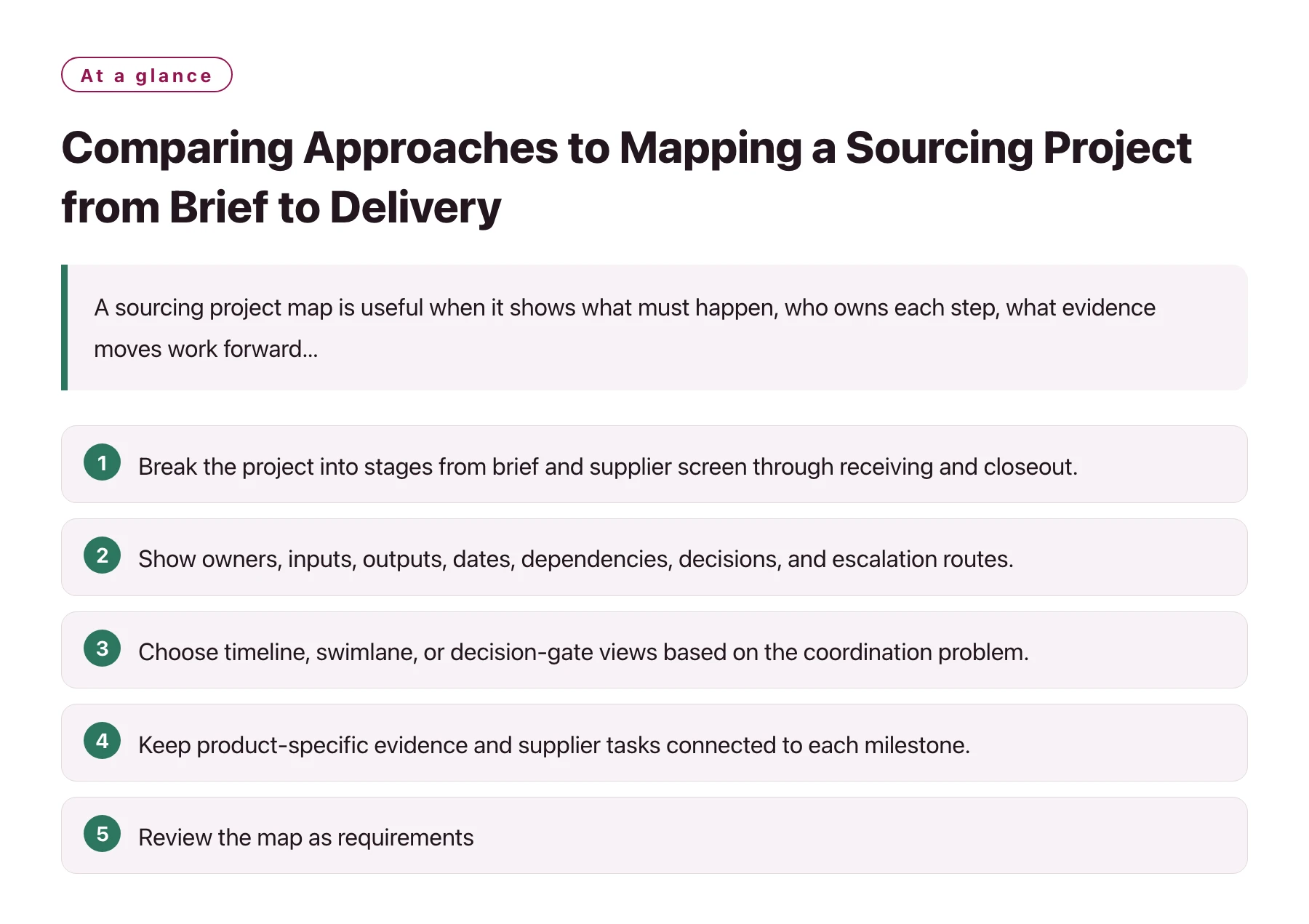
Key takeawaysBreak the project into stages from brief and supplier screen through receiving and closeout. · Show owners, inputs, outputs, dates, dependencies, decisions, and escalation routes. · Choose timeline, swimlane, or decision-gate views based on the coordination problem. · Keep product-specific evidence and supplier tasks connected to each milestone. · Review the map as requirements, approvals, quantities, or delivery assumptions change.
A compact map is better than a detailed diagram that no one updates or uses to make decisions.
Define what the project map must help people do
Start with the intended decisions: compare suppliers, approve a sample, authorize production, clear a quality finding, release shipment, or confirm receipt. A map designed to show dates may not reveal who can accept a deviation. A map designed to assign owners may not expose a dependency between a test report and a purchase order. Write the decision need before choosing a visual format.
Set the project boundary. It may begin with an approved requirement brief or supplier discovery and end at factory dispatch, destination receipt, installation, or a defined closeout. Name which teams and suppliers are included and which processes remain external. Avoid treating a procurement diagram as a substitute for a customs broker’s, laboratory’s, or carrier’s operational instructions.
For teams coordinating with js-sourcing.com, maintain one map per project or workstream and link it to the versioned specification, quote, inspection plan, and shipment file. A clear source of truth prevents the diagram from becoming another stale copy of the order details.
Build a stage map for the end-to-end sequence
A simple stage map can show brief, supplier search, capability review, quotation, sample, technical approval, purchase order, production, inspection, release, transport, receiving, and retrospective. Place gates between stages where a decision is required. For each stage, list entry conditions, expected output, owner, target date, and the next responsible party.
Use the stage map when stakeholders need an overview of sequence and elapsed time. It works well for presentations, onboarding, or early planning, but can hide concurrent tasks and cross-team handoffs. Add dependencies where one task cannot begin before another, such as a finalized drawing before sample approval or a lot-ready notice before an inspection booking.
Mark rework loops rather than drawing a one-way ideal path. A rejected sample may return to design or supplier clarification; a failed inspection may trigger containment, repair, or re-inspection. Show the owner and records needed for the return path so exceptions do not disappear from the plan.
Use swimlanes to expose handoffs
A swimlane map separates responsibilities by buyer, sourcing provider, manufacturer, quality inspector, freight forwarder, broker, and receiving team. Put actions and evidence in the lane of the party that performs or owns them. Arrows show handoffs, while decision diamonds or labels identify who has authority to accept, reject, or hold.
Use swimlanes when work often stalls between functions or when a task’s owner is disputed. They can reveal that supplier quotation, technical review, payment, and inspection booking depend on different people. Keep lanes at the level of actual accountability; too many individuals or departments can make the map unreadable.
Check that every handoff names its input and output. For example, a supplier’s production-ready notice should include model, quantity, date, and site; the buyer’s response should identify inspection booking or unresolved blockers. A simple arrow labeled “send documents” is not enough if no one knows which documents or who verifies them.
Use decision gates for approvals and risk controls
Decision gates identify conditions that must be satisfied before the project advances. Examples include supplier approval, technical sample acceptance, contract execution, production authorization, inspection disposition, document completion, and shipment release. List the evidence, decision owner, allowed outcomes, and consequences for each gate.
Use a gate map when the main risk is proceeding without an approval or when a decision changes cost, product, safety evidence, or schedule. The gate should not imply that a single signature resolves matters outside its scope. A commercial approver may accept a price change but should not automatically approve a technical substitution.
Define exceptions and conditional approvals. If production may start while one noncritical document is pending, identify the remaining condition, due date, affected work, and person authorized to accept the exposure. If the condition fails, specify whether work pauses, rework starts, or the shipment remains on hold.
Compare map formats and choose by use
A milestone timeline highlights dates and sequence. A swimlane emphasizes ownership and communication. A decision-gate map highlights controls and approval logic. A dependency network can show complex task relationships and critical paths. Select the smallest number of views that answer the project’s real questions; not every sourcing project needs a large process diagram.
For a simple repeat order, a checklist and milestone table may be easier to maintain than a flowchart. For multiple suppliers or categories, swimlanes can reveal parallel work. For a regulated or technically complex product, decision gates can make evidence and review authority explicit. Combine formats only when users need them and keep consistent IDs across views.
Keep the map linked to current records rather than duplicating all detail inside it. Use stable references for product, supplier, order, and document revisions. This allows the map to remain concise while teams can open the underlying evidence when they reach a milestone.
Define milestone evidence and status
For each step, distinguish planned, forecast, actual, and blocked status. Record who updated it and when. A color alone is ambiguous; add text or a reason field. If a milestone depends on supplier information, link to the message or document and mark whether the buyer has verified it. This makes a status report auditable and reduces false confidence from an optimistic update.
Set completion criteria. “Sample approved” should identify which sample and attributes; “inspection passed” should refer to the report and lot; “shipment released” should name the authorized approver and final evidence. These definitions make separate teams less likely to interpret the same status differently.
Add a decision log for changes to specification, quantity, price, schedule, delivery term, inspection scope, or responsible party. Link each decision to its approver and affected documents. Update the map when a change alters dependencies or risk, not for every minor communication.
Show commercial and logistics responsibilities
Map when quotes are normalized, contracts are signed, deposits are paid, balance payments are triggered, freight is booked, and import documents are reviewed. Identify the owner, required evidence, and payment or release consequence at each step. Ensure the commercial path aligns with production and quality gates.
State the delivery term and exact named place in the contract. The U.S. International Trade Administration explains that Incoterms allocate specified buyer and seller tasks, costs, and risks, including transport, insurance, documentation, and customs activities. [1] The map should then show any additional work, such as broker coordination or final-mile booking, that still needs an owner.
Include handoffs from factory readiness to forwarder, customs broker, destination warehouse, and site receiver. List package data, booking references, invoices, packing lists, and any required product records. If partial shipment is permitted, show how each lot is released and tracked separately.
Make the map useful for exceptions
Add a small set of exception paths for the failures most likely to affect the project: sample mismatch, late materials, unapproved substitution, failed inspection, missing certificate, payment query, booking delay, damage, or customs hold. For each, identify detection point, containment action, escalation owner, decision authority, and communication route. Avoid diagramming every theoretical possibility.
Specify stop-work or hold conditions. A missed delivery date may require replanning, while a safety-related document gap may prevent shipment release. The map should show which issues are managed as schedule risks and which require technical or compliance review. Use the contract and project’s qualified owners to set the triggers.
Test the map in a short walkthrough with people who will use it. Ask each participant what they do next when a realistic event occurs and what evidence they need. If answers differ, revise the map or clarify the responsibility before the project is underway.
Maintain and close the project map
Assign a map owner and a review cadence. Update the map after a product change, supplier change, revised delivery date, new approval condition, or transfer of responsibility. Archive obsolete versions and identify the version used for each order. A map with no owner quickly becomes a historical diagram.
At closeout, compare planned and actual milestones, decision delays, quality findings, document gaps, cost changes, and delivery. Record which handoffs worked and which required escalation. Use observations to simplify the next workflow and improve templates. Avoid adding controls that do not address a real failure mode.
Keep lessons scoped to the product and project. A process that worked for one supplier or simple product may not suit a different market or risk profile. Reuse stable project controls while reassessing technical evidence, market requirements, and logistics for each new order.
Sources
Frequently asked questions
Which sourcing project map is easiest to start with?
A milestone table with owners, due dates, dependencies, evidence, and decisions is often a practical first view. Add swimlanes or gates when handoffs need more detail.
When should I use swimlanes?
Use swimlanes when work crosses buyer, supplier, quality, logistics, and compliance roles, especially if unclear ownership or handoffs are delaying the project.
How detailed should a sourcing map be?
Show the stages, owners, evidence, decisions, and exceptions needed to act. Link to detailed specifications and records instead of copying everything into the diagram.
Who should maintain the map?
Name one project owner to keep it current, while each lane owner supplies status and evidence for their assigned work.