Large beer production depends on how much usable wort and finished beer a brewery can move through each stage per hour, not only on tank size. A 100 hL brewhouse completing 8 brews can produce about 800 hL of wort in 24 hours, while a 400 hL fermenter can receive four such batches. At 90% overall packaged yield, 800 hL of wort becomes roughly 720 hL of saleable beer. Brewhouse cycle time, fermentation capacity, cooling, CIP, utilities, and packaging speed must therefore be sized together. Automated controls also hold temperature, flow, pressure, and cleaning conditions within repeatable ranges across hundreds of production cycles.
A large brewery starts with throughput calculations. A 50 hL brewhouse producing one batch every 3 hours reaches about 400 hL over eight batches; reducing the interval to 2 hours raises theoretical daily wort output to 600 hL without increasing vessel volume. Separate mash, lauter, kettle, and whirlpool vessels allow one batch to boil while another is filtered and another begins mashing, so equipment occupancy overlaps rather than waiting for one vessel to perform every process.
That higher brew frequency also increases malt handling requirements. A typical all-malt beer can require roughly 15–25 kg of malt per hectoliter depending on original gravity, recipe, and brewhouse extraction. At 800 hL per day, that range represents about 12–20 metric tons of malt. Bulk silos, mills, screw conveyors, bucket elevators, load cells, and grist cases replace repeated manual handling and give operators measured inputs for every brew.
Milling quality affects what happens in the lauter tun. Excessively fine material can slow wort separation, while coarse milling can leave usable extract inside larger particles. If one production line uses 15 metric tons of malt per day, improving brewhouse extract recovery from 80% to 82% changes how much useful extract reaches the wort from the same raw-material input. Over 300 production days, a 2-percentage-point difference becomes large enough to influence annual malt purchasing.
Large-scale equipment earns capacity through time as much as through volume. A 100 hL vessel occupied for 180 minutes supports fewer brews than the same nominal volume completing its stage in 120 minutes, even though both tanks hold exactly the same amount.
Mash vessels therefore need enough heat-transfer area and agitation to keep large volumes reasonably uniform. A 100 hL mash contains around 10,000 liters before allowing for grain displacement and recipe differences. Temperature sensors, jacketed heating zones, steam controls, agitators, and automated water addition help maintain programmed rests. A deviation of 1–2°C can alter enzyme activity, fermentability, and wort composition, so industrial systems record temperature continuously rather than relying on occasional manual readings.
Wort separation becomes the next timing limit. Lauter tuns use slotted false bottoms, rakes, sparging systems, differential-pressure monitoring, and controlled wort collection to separate liquid from grain beds. A filtration stage taking 120 minutes instead of 90 minutes adds 30 minutes to vessel occupancy. Repeated over 8 brews, that difference represents four hours of accumulated processing time, although overlapping vessels can absorb part of it.
Equipment selection can therefore be compared by practical production effects rather than nominal tank volume alone:
| Production area | Example operating figure | Production effect |
|---|---|---|
| Brewhouse | 100 hL × 8 brews | 800 hL wort/day |
| Malt handling | 15–25 kg/hL | 12–20 t malt at 800 hL/day |
| Fermenter | 400 hL working volume | About 4 × 100 hL brews |
| Cellar residence | 14 days | About 11,200 hL entering cellar over the period |
| Packaged yield | 90% | 720 hL from 800 hL input |
| Can line | 24,000 × 330 mL cans/hour | 79.2 hL/hour before stoppages |
Boiling then adds a substantial thermal requirement. Heating 10,000 liters of wort by tens of degrees requires hundreds of kilowatt-hours of thermal energy before boiler, pipe, and vessel losses are considered. Steam jackets, internal boilers, external wort boilers, insulation, condensate return, and automatic steam valves allow heat to enter the product at a controlled rate. An evaporation target around 4–10% per hour may be used depending on kettle design, beer specification, and process requirements rather than applying the same setting to every recipe.
Hot wort leaving the whirlpool carries recoverable heat. Cooling 10,000 liters from about 95°C to 20°C removes roughly 870 kWh of thermal energy when estimated from water-like heat capacity. A plate heat exchanger can transfer much of that heat into brewing water while cooling wort for fermentation. The exchanger must also match brewhouse flow: processing 100 hL in 60 minutes requires an average wort rate near 167 liters per minute.
Cooling speed connects the brewhouse with the cellar. A brewery producing 800 hL each day and holding beer in tanks for 14 days sends about 11,200 hL through the fermentation schedule during that period, before headspace, cleaning, beer variety, and residence-time differences are added. A cellar with only 6,000 hL of usable fermentation volume cannot continuously accept 800 hL every day under a 14-day schedule.
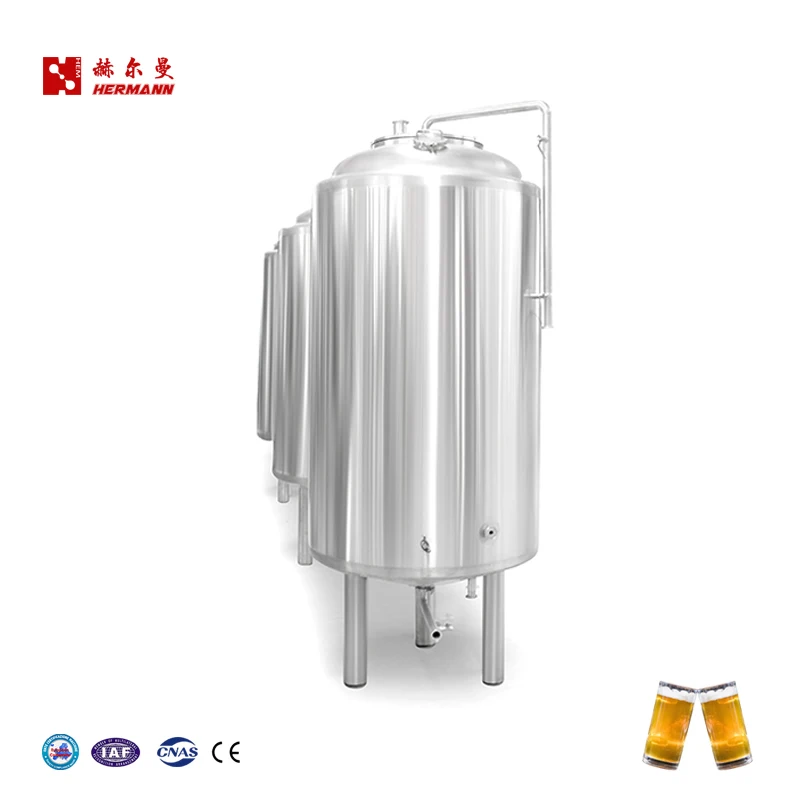
That capacity gap explains why large cylindroconical fermenters often hold several brewhouse batches. A nominal 400 hL tank may receive four 100 hL brews, subject to its permitted working volume and required headspace. Cooling jackets are divided into zones because beer temperature and cooling demand vary along a tall tank. Pressure instruments, sample ports, yeast outlets, cleaning heads, and temperature probes give operators access to the process without opening the vessel.
Fermentation equipment also affects scheduling. A beer occupying a tank for 10 days gives the same vessel about 36 theoretical cycles per year before maintenance and cleaning; a 20-day product gives about 18. A brewery making several beer styles therefore cannot calculate annual capacity from tank volume alone. Tank-days provide a better production measure because 400 hL held for 20 days uses twice as much cellar time as 400 hL held for 10.
At smaller commercial scales, micro brewery equipment often uses similar process stages with fewer vessels and lower hourly throughput. Moving toward larger output usually adds dedicated vessels, automated valves, larger heat exchangers, more cellar volume, and more extensive utility distribution. The brewing chemistry remains familiar, while the number of transfers, cleaning operations, instrument readings, and simultaneous batches grows sharply.
Automation helps manage that larger number of operations. PLC systems can sequence pumps and valves, regulate mash temperature, meter water, stop transfers at specified tank levels, control steam supply, and record batch data. If a brewery runs 8 brews per day for 300 days, operators manage about 2,400 brewhouse cycles per year. A repeatable automated valve sequence removes thousands of individual manual valve movements from that schedule.
The same reasoning applies to sanitation. Cleaning-in-place systems circulate water, caustic or other approved cleaning solutions, acid where required, and final rinses through vessels and pipework. Temperature, circulation time, chemical concentration, and flow conditions are monitored because simply filling a tank with cleaning liquid does not confirm adequate cleaning. Reducing a 3-hour tank turnaround to 2.5 hours saves 30 minutes; across 300 cleaning cycles, that produces 150 hours of additional equipment availability.
-
A 200 hL tank cleaned with 3,000 liters instead of 4,000 liters per complete cycle saves 1,000 liters each time.
-
Across 250 cycles, the difference reaches 250,000 liters of water.
-
Reducing a product loss from 5% to 4% on 50,000 hL of annual production retains about 500 hL more beer within the measured process boundary.
-
A 1% packaging loss on 1 million 330 mL cans corresponds to about 3,300 liters of product.
Water, refrigeration, steam, compressed air, electricity, and CO₂ supply have to follow the same production schedule. A 100 hL brewhouse cannot maintain its rated output when the hot-water tank needs another 40 minutes to recover between brews or the glycol plant cannot remove fermentation heat from the cellar. Utility equipment is therefore sized around simultaneous demand periods, not just daily averages.
Packaging creates another capacity check. A line rated at 24,000 cans per hour processes 7,920 liters per hour when using 330 mL cans, equal to 79.2 hL before stops, changeovers, rejects, and cleaning. At 85% operating efficiency, the practical figure falls to about 67 hL per scheduled hour. Packaging 720 hL would then require roughly 10.7 operating hours rather than the 9.1 hours suggested by the nameplate rate.
Measurement closes the gap between nameplate specifications and actual production. Flow meters can compare water input with wort and beer output; level sensors show vessel occupancy; conductivity instruments help separate cleaning solution from rinse water; power meters show refrigeration demand; and production software records cycle duration. A repeated 15-minute delay across 8 daily brews creates 120 minutes of lost brewhouse time each day and about 600 hours across 300 operating days.
Equipment layout also affects those minutes. Shorter sanitary pipe routes reduce transfer volume, valve manifolds reduce hose changes, and dedicated product lines reduce waiting between cellar operations. A 50-meter pipe with a 50 mm internal diameter contains roughly 98 liters. If the line must be flushed during every product change, 10 additional changeovers can involve almost 1,000 liters of pipe volume before the volume needed for cleaning and rinsing is counted.
Production planning therefore compares vessel occupancy, process rate, and actual yield at every stage. An 800 hL/day brewhouse paired with 400 hL/day packaging capacity eventually fills finished-beer storage, while a large packaging line receives little benefit when fermentation supplies only 300 hL/day. Large production comes from matching hourly and daily capacities across brewing, fermentation, cleaning, utilities, storage, and packaging, with enough spare capacity to handle cleaning periods, recipe changes, maintenance, and normal production variation of several percent.