The Long Target: Planning 0.05 BTC Around Difficulty, Not Dates
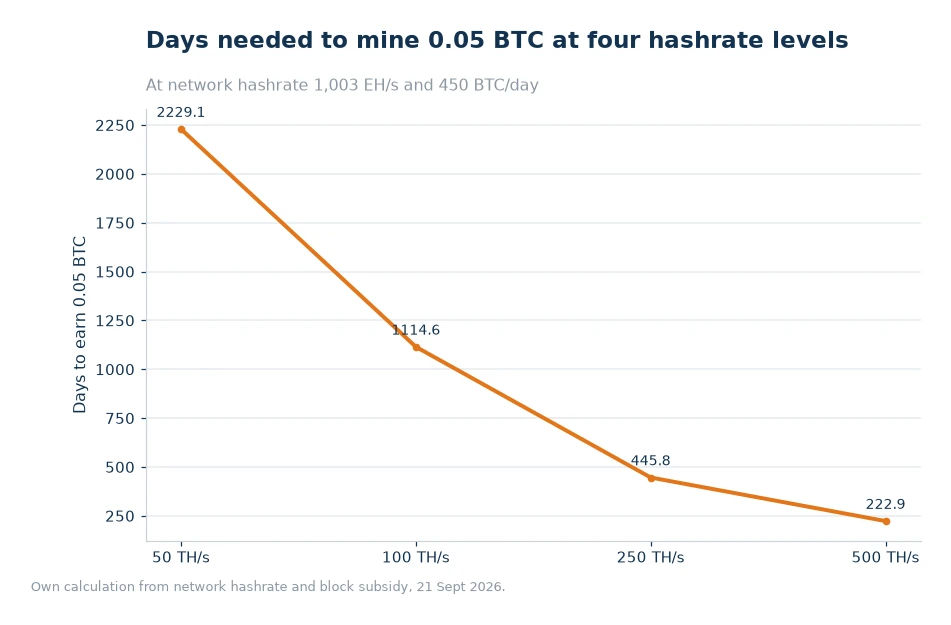
A 0.05 BTC goal is easier to read as money than as coin: $4,234.60 at $84,692. At 50 TH/s it takes 2229.1 days of average output, while 500 TH/s brings it down to 222.9 days. The gap between those two numbers is the entire planning problem.

Key takeaways
- 0.05 BTC is worth $4,234.60 at $84,692, which is the number to plan against rather than the coin count.
- 50 TH/s needs 2229.1 days of average output; 500 TH/s needs 222.9, a tenfold difference.
- At 250 TH/s the target takes 445.8 days, or about 14.9 months of thirty-day cycles.
- Pool hashrate sets your share of rewards, but difficulty is the force that stretches a long schedule.
Turn the target into money before anything else
A coin target feels concrete and is not. The same 0.05 BTC was worth a different amount last month and will be worth another amount next month. Converting it to dollars at the read date gives a figure you can compare with hardware costs, power bills and the price of simply buying the coin instead. That comparison is uncomfortable and useful: mining converts electricity and capital into coin over time, and the arithmetic should be seen next to the alternatives.
The conversion also clarifies what a schedule means. If the target is $4,234.60 and the daily gross at your hashrate is $1.90, the wait is measured in years regardless of how the coin price moves, because both sides of the comparison move together. Price changes the dollar value of the target and the dollar value of the output at the same time, which is why a target expressed in coin is more stable for planning than one expressed in dollars.
Hashrate is the throttle
Daily output is linear in hashrate. Double the hashrate and the target arrives in half the time, as long as difficulty and price hold. The table lays out that relationship at four levels, with the monthly rows showing how a long target looks when it is chopped into billing cycles.
| Elapsed months | BTC accumulated | Share of target | USD at $84,692 |
|---|---|---|---|
| 1 | 0.00336450 | 6.7% | $284.94 |
| 3 | 0.01009350 | 20.2% | $854.83 |
| 6 | 0.02018700 | 40.4% | $1,709.67 |
| 12 | 0.04037400 | 80.7% | $3,419.37 |
Twelve months of thirty-day cycles is 360 days, which is less than the 445.8-day total, so the last row sits below 100%. The remaining 85.8 days finish the job at the same rate. This is the kind of detail that makes a target date slip: months are not all thirty days, and a plan built on round months drifts by about a week a year.
The denominator you cannot control
Two hashrate figures sit behind every credit. The pool's determines your slice of its rewards; the network's determines how much those rewards are worth in coin. Over a multi-year target, the second one dominates. The network hashrate in this reading was about 1,003 EH/s, and the difficulty estimate was −2.12% at the next adjustment, a rare moment of relief rather than a trend.
The ViaBTC Pool Hashrate page shows the first figure live. Watch it long enough and you will see it move by a few percent a month, which is small next to the changes in the network total. That is the reason experienced miners check the pool page for reliability and the statistics page for economics, rather than treating both as the same kind of number.
There is a second-order effect worth naming. When a pool's hashrate grows, your share of that pool falls, and the pool's block discovery rises in proportion. The product is unchanged, but the timing changes: more blocks per day means shorter gaps between PPLNS payments, which makes a long schedule easier to monitor. When a pool's hashrate falls, the opposite happens, and the schedule becomes lumpier without becoming worse on average.
Worked example
- Supply: 144 blocks at 3.125 BTC is 450 BTC a day.
- Spread over 1,003,000,000 TH/s: 0.0000004486 BTC per TH/s.
- 50 TH/s: 50 × 0.0000004486 = 0.00002243 BTC each day.
- Days to 0.05 BTC: 0.05 ÷ 0.00002243 = 2229.1 days, about 6.1 years.
- 100 TH/s halves it: 0.00004486 BTC a day, 1114.6 days.
- 250 TH/s: 0.00011215 BTC a day, 445.8 days, or 14.9 thirty-day months.
- 500 TH/s: 0.00022430 BTC a day, 222.9 days, or 7.4 months.
- At $84,692 the target is 0.05 × 84,692 = $4,234.60, and the 250 TH/s monthly pace is 0.00336450 BTC, or $284.94.
Why long schedules drift
A six-year target assumes difficulty, price and uptime hold for six years. None of them will. Difficulty has risen over most long windows, which pushes the finish line further away; price has moved in both directions, which changes the dollar value without changing the coin count. A schedule built on one day's inputs is a starting estimate, not a forecast.
The practical response is to shorten the planning horizon. Plan the next ninety days precisely, the next year roughly, and treat anything beyond that as a direction rather than a date. Recomputing the days-to-target figure with the Profit Calculator takes a few minutes and keeps the expectation honest as conditions change.
The other response is to keep a buffer of hashrate or coin. A miner who is 10% ahead of the schedule at the six-month mark can absorb a difficulty rise without changing anything. One who is exactly on schedule has no slack, and the first adjustment turns the plan into a negotiation.
Pool Luck over a long horizon
Over years, Pool Luck averages toward 100% for any pool large enough to find many blocks, which is why it is the least important variable in a long target. What does not average out is uptime. A machine offline for a week each quarter loses roughly 7.7% of its annual output, which is several months on a six-year schedule. Maintenance, spare parts and a monitoring routine matter more than the luck percentage.
Scheme choice interacts with the horizon too. A PPS+ miner receives steady hourly credits at a listed 4% on the block-reward component, which makes monthly reconciliation simple. A PPLNS miner accepts more variation for a listed 2% rate on the combined components. Over a long target the difference in average is small; over a short cash-flow window it is not.
The comparison the target invites
Mining is one of two routes to 0.05 BTC: run hardware and wait, or buy the coin. The first costs hardware plus the power consumed across the schedule; the second costs the market price at the moment of purchase. Mining spreads the cost and delays the coin, while buying reverses both. Neither is universally cheaper, and the answer moves with the tariff and with the resale value of the machine.
The useful part of the comparison is that it drags the schedule into the open. At 250 TH/s the 445.8-day route consumes a known number of kilowatt-hours, which can be priced today, against a target whose price today is $4,234.60. Those are two concrete figures. A plan that cannot produce both is not a plan yet, whatever hashrate appears on the order sheet.
Frequently asked questions
How long does 0.05 BTC take at 50 TH/s?
About 2229.1 days at the 21 September 2026 reading, which is roughly 6.1 years, because 50 TH/s credits 0.00002243 BTC a day. At 500 TH/s the same target takes 222.9 days.
Does a rising coin price shorten the wait?
Not in coin terms. It raises the dollar value of the target and of the daily output at the same time, so the number of days needed to accumulate 0.05 BTC is unchanged by price alone.
What if difficulty keeps rising?
Each rise lengthens the schedule. Recompute the days-to-target figure monthly, and treat any plan longer than a year as a direction rather than a fixed date.
Check the pace, not the finish line
Measure progress in thirty-day blocks and compare each one with the arithmetic. When a block comes in short, attribute the gap before changing anything: uptime, difficulty and hashrate are the three candidates. The multi-currency wallet keeps the accumulated coin in the same account as the mining dashboard, which makes the monthly check a single screen rather than a reconciliation project.
Sources: ViaBTC's pool state, wallet and pricing pages, for pool hashrate, balance handling and the listed 4% and 2% rates[1]. Read 21 Sept 2026: BTC $84,692, network 1,003 EH/s, difficulty 132.76 T, next estimate −2.12%, subsidy 3.125 BTC over 144 blocks a day. The schedule assumes continuous uptime. Published 22 Oct 2026.